
Punishing Droughts Put Fresh Pressure on Meat and Dairy Production
- Serena Valentino
- Aug 31, 2025
- 3 min read
By Clara Hudson | Aug. 26, 2025 12:12 pm ET|WSJ Pro
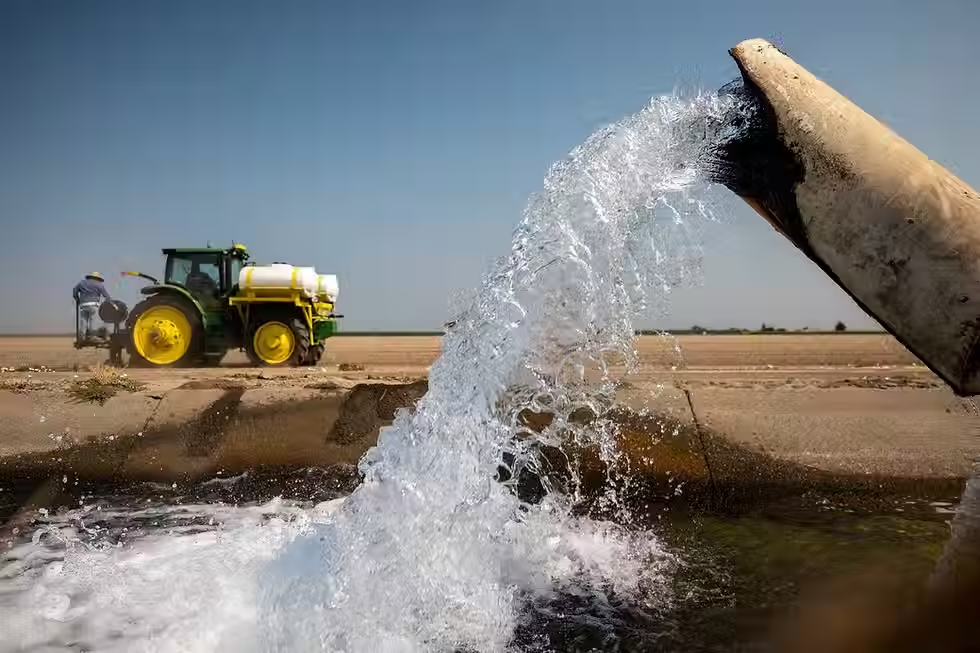
Investors are calling for farm-based businesses to address increasing concerns about their water use
Investors have an unexpected worry: access to water.
Droughts have hit countries around the globe from Spain to Syria this year and parts of the U.S., including farm-heavy North Carolina. Worries about increasingly high temperatures have investors wondering how farming businesses are dealing with water shortages.
Meat and dairy farms rely on water to hydrate their animals, grow crops to feed them and even to cool them off in extreme heat. Two-thirds of livestock companies surveyed by an investor group aren’t properly managing potential water shortages, “indicating widespread failure to manage water-related risks effectively,” according to a report published on Tuesday.
The report, by the Farm Animal Investment Risk and Return Initiative, a global investor network representing $80 trillion in assets, analyzed water risk for 60 large global meat, dairy and aquaculture companies. The FAIRR initiative provides investors with research on risk to the animal agriculture industry.

“The growing appetite for water-intensive agricultural products is threatening not only ecosystems and communities, but also the long-term stability of agri-food markets and investor returns,” the report said.
Investors need to know how companies are planning to secure water in regions where droughts are rife, the report said. But 44 of the meat, dairy and aquaculture businesses surveyed didn’t provide any such data, according to the report, with only 10 setting targets to reduce their exposure to water insecurity. Only one company—Vital Farms, a U.S.-based egg and dairy product producer—disclosed where it gets its water from.
FAIRR has partnered with other investor organizations to push fast food companies, including Chipotle and Wendy’s, to divulge any plans on reducing their water consumption, too.
Water insecurity is causing uncertainty in supply chains and driving down crop yields, the report says, also emphasizing that the level of water risk depends on geography—for example, India and the U.S. are particularly water-stressed regions.
Demand for freshwater is set to exceed supply by 40% by 2030, according to the Global Commission on the Economics of Water, a group set up by the Organization for Economic Cooperation and Development.

“Water risk is no longer a distant environmental concern, it’s a material financial issue that will shape markets over the next decade,” said Sudip Hazra, director of the First Sentier MUFG Sustainable Investment Institute, which conducts environmental, social and corporate-governance research.
The issue is getting political, too. Texas farmers pushed President Trump to pressure Mexico into providing water amid a drought earlier this year, leading him to threaten Mexico with tariffs. The U.S. and Mexico share water from the Rio Grande and the Colorado River, an agreement which has been in effect since the mid-1940s.
The American Farm Bureau Federation says on its website that farmers can reduce water use by up to 40% by getting moisture directly to each plant through drip irrigation. The group said it’s also hopeful about advances in humidity-sensing technology that helps farmers gauge how much water each crop needs “down to the drop.”
Water use concerns have also risen as big tech guzzles water to cool data centers that power artificial intelligence.
“Just as big tech—and especially artificial intelligence—faces scrutiny over their water use, a handful of highly dependent agri-food companies hold outsized influence in building water resilience,” said Henry Throp, research manager at FAIRR.
Droughts can drive up costs because without enough water, businesses have to buy more feed instead of relying on grazing lands, said Karina Schoengold, a professor of agricultural economics at the University of Nebraska-Lincoln.
“It is important to consider not only the water that the animals consume, but also the water used to grow animal feed,” she said.
Write to Clara Hudson at clara.hudson@wsj.com )Visit WSJ for original article)
Copyright ©2025 Dow Jones & Company, Inc. All Rights Reserved. 87990cbe856818d5eddac44c7b1cdeb8
Appeared in the August 27, 2025, print edition as 'Severe Droughts Pressure Meat and Dairy Production'.


Comments