
Farmers Are Aging. Their Kids Don’t Want to Be in the Family Business.
By Patrick Thomas | Photography by Whitney Curtis for WSJ
Feb. 14, 2026 9:00 pm ET
MARSHALL, Ill.—Don Guinnip is running out of time.
The fifth-generation farmer still wakes early each morning to tend to roughly 1,000 acres of corn and soybeans and 40 cattle. But four decades of grueling work, a bout with prostate cancer and surgery to replace both of his hips with titanium implants have taken their toll.
The 74-year-old estimates he can maintain the current workload for a couple more years.
Under the gaze of generations of Guinnips in black-and-white photos, he gathers his four siblings to chart the future of their family’s farm—and contemplates a day when a Guinnip no longer cares for the land that runs along Guinnip Road.
The natural choice to take over, his son and daughter, left for college and now work in corporate fields. His siblings made the same decision years earlier.
“It’s disappointing to me,” Guinnip says, holding back tears. “That’s the way the dice were rolled, and you have to accept what life gives you.”
The number of farmers in America has been shrinking for years, but rising costs and weak commodity prices are pushing more families out at a faster rate. In 2025, 315 farms filed for bankruptcy, up 46% from 2024, U.S. court data shows.
Those left are aging; there are more farmers 75 and older than under the age of 35, according to the U.S. Department of Agriculture. They are facing tough choices and tougher prospects.
“Family agriculture is in crisis, and American farmers and ranchers are fighting for their livelihoods,” says National Farmers Union President Rob Larew.
Many farmers already rely on government bailouts to stay afloat. In 2024, Congress approved $10 billion in bailout funds and $21 billion in natural disaster relief for growers and ranchers. The Trump administration’s trade policies exacerbated the situation, pushing more families and communities to the brink. In December, the White House pledged $12 billion in aid to farmers. Even with that money, corn growers are expected to be in the red again in 2026, industry estimates show.

Thousands across the U.S. are closing the book on farms that have been in their families for generations, either by selling to a larger entity or declaring bankruptcy. It has transformed food production and local communities. Critics of farm consolidation say it’s also led to less crop diversity, presenting risks for the broader food system.
The disappearance of small farms has carried steep consequences for rural America, upending the transfer of wealth—long attached to the land—between generations. And the tough economics are making the search for successors more challenging. Children of farmers today have more opportunities to work beyond agriculture than they did decades ago, and families are typically smaller, shrinking the pool of possible candidates.
Seated around the living room, Guinnip and his siblings dig into packets filled with appraisals and farm history as they discuss plans for land potentially worth millions of dollars.
While Guinnip has sole oversight of the acres and animals, his parents left the family farm in trusts that split ownership between him, David, Susan, Sallie and Dan. Every year, Guinnip pays his siblings rent based on the farm’s performance.

The profits aren’t much these days, but it could be worse.
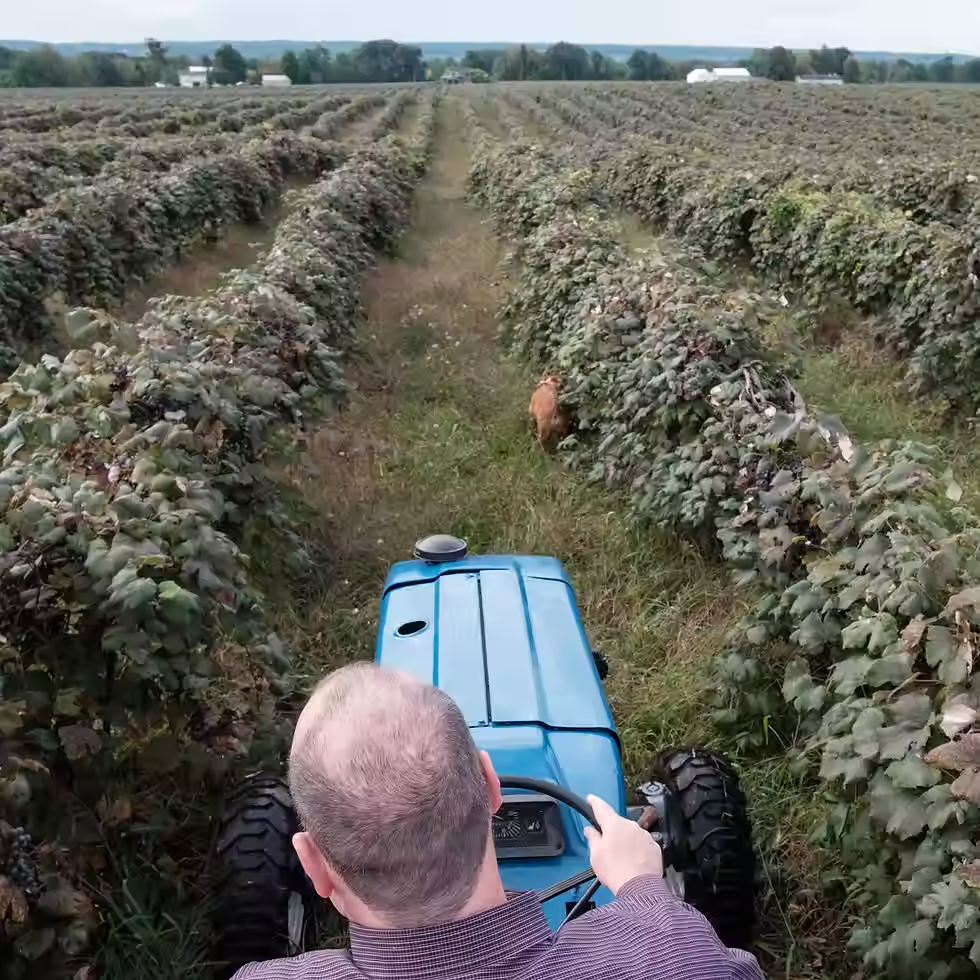
One thing that helps: Guinnip is frugal. He still lives in the more than century-old house his grandfather built. His truck, which recently lost power steering, is from the 1990s. Instead of buying new equipment and hiring help, he uses an aging tractor and combine.
“Why would I buy new equipment if I have no one to pass it along to?” he says.
On Guinnip Road
With calls of “sook calf,” Guinnip starts the day the same way his father and grandfather did before him. He treks the gravel path behind the farmhouse to a small pasture tucked between rows of corn and soybeans. One by one, cattle fall behind him single file to consume a breakfast of ground corn and hay.

Guinnip handles just about every task around the farm. He hauls buckets of feed into the back of his ATV and unloads them in a pen crowded with cattle that outweigh him many times over. With the hip replacements, he’s limber enough to climb into the large machinery needed to harvest crops, spray pesticides, plant seeds and move hay bales that weigh roughly 1,000 pounds each.
Reminders of his lineage dot the land, starting with the sign in front of the farm pointing to the start: 1837.
Family patriarch Joseph Guinnip joined the throngs of people who headed west to take hold of America’s Manifest Destiny, leaving Steuben County, N.Y., in the 1830s. He eventually settled 40 acres of land in southeastern Illinois, where he built a log cabin, the family’s first farmhouse.
The land has passed through every generation since, including those who fought in the Civil War and survived a buzz-saw accident. Guinnip’s father, Robert, and mother, Rose, eventually took their turn at the helm.
Visit The Wall Street Journal for the original article.


Comments