
Driscoll’s Gave China Its Blueberries—Then China Swiped the Secret to Growing Them
By Jon Emont | Photography by Qilai Shen for WSJ Sept. 14, 2026 9:00 pm ET
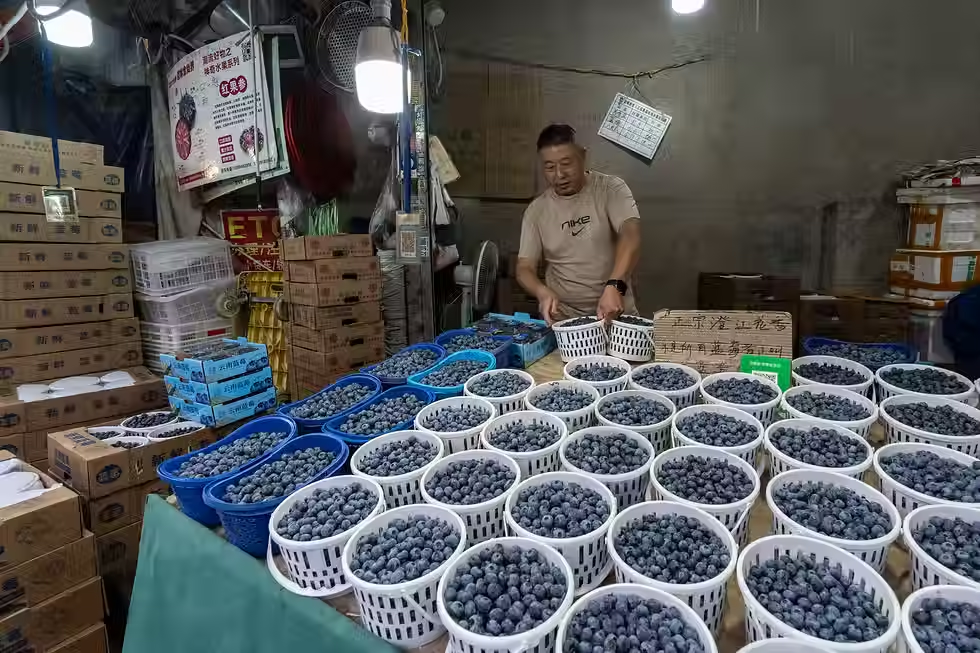
California grower’s expansion into China ignited local competition and widespread IP theft; undercover investigators at nurseries
QUJING, China—About 15 years ago, executives from U.S. fruit grower Driscoll’s went to China with a goal of turning blueberries into that country’s next big food trend.
The California company dispatched one of its experts to scout farmland in southwestern China’s Yunnan province, contracted with global blueberry-genetics firms to lock up the best varieties and brought in high-tech growing technologies to mass produce a fruit few Chinese people then ate. By 2020, it was cranking out thousands of tons of blueberries for Chinese supermarkets.
Then it became the latest U.S. company to encounter the buzzsaw of Chinese competition.
As tales of blueberry fortunes spread, Chinese entrepreneurs rapidly built farms of their own. They adopted high-tech growing techniques similar to Driscoll’s, even allegedly copying greenhouse designs used by farmers growing for Driscoll’s. They also swiped the company’s patent-protected varieties, a Chinese court has ruled. State banks fed the rush, offering a special category of loans for blueberry growers.
Production in China has shot up 25-fold since 2010. In 2021, China overtook the U.S. as the world’s top blueberry grower, and by 2025 its annual production was double what it was in the U.S.
For Chinese consumers, it was a blueberry bonanza. Prices dropped so low—often $3 or less for a 9-ounce container—that state media trumpeted an era of “blueberry freedom,” in which even ordinary people can gorge on a once-exotic fruit.
For just about everyone in the blueberry business, though, it has been a knife fight, plagued by intellectual-property theft and tanking profits.
It is a pattern seen across many industries in China, especially as economic growth slows. Companies in search of new sources of profit jump into promising emerging businesses, using inexpensive state-backed financing to scale up—and sometimes play fast-and-loose with intellectual property regulations. This quickly causes gluts, crashing prices.


Such cycles of competition are known in China as involution, and they have transformed the country from a golden goose into a major headache for companies including Nike and Starbucks.
Driscoll’s has filed more than 20 lawsuits against companies in China, some of which it has said took its proprietary blueberry plants, propagated them and sold them to rival growers. Some Western fruit companies worked with private investigators who went undercover at plant nurseries, posing as traders or farmers so they could buy plants and hustle them off to labs for DNA testing to prove they were pirated.
The “sheer volume of illegal nurseries and plantings means many thousands of illegal hectares will continue in operation as they are, with thousands more to come,” the International Blueberry Organization, a global trade group, warned in an August report.
China resisted for decades developing the kinds of large, corporate farms that turned the U.S. into an agricultural powerhouse. Now, with some ingenuity, technology and copycat tactics, it is becoming competitive in more farm products, and big agricultural companies are playing a larger role.
It is growing new cash crops such as avocados and durian, and is producing so much tomato paste that Italian farmers launched a protest flotilla two years ago to oppose the unloading of Chinese tomato products in the port of Salerno.

Satellite data from University of Copenhagen academics, published in the journal Nature Food, showed that some 60% of the world’s greenhouses were in China in 2019, dramatically increasing fruit and vegetable yields. More recent data puts the figure even higher.
Farmers worldwide had hoped China’s 1.4 billion mouths would continue devouring more foreign produce. Although the country still imports large quantities of soybeans, beef and dairy products, agricultural imports have stagnated in recent years as food output increases. China agreed to allow fresh American blueberry imports in 2020, but expanding domestic production and tariffs have shut U.S. farmers out of the market.
“It’s like, welcome to China,” said David Smith, a fruit-industry consultant in Shanghai. “Whatever they get into, they just dwarf other countries once they decide to grow it.”

Planting seeds
Privately held Driscoll’s, which traces its roots to two enterprising strawberry growers in early 1900s California, became America’s biggest berry producer by working with hundreds of independent growers nationwide. It provided its proprietary plant varieties to farmers, who would plant and harvest strawberries, blueberries and other fruits sold in Driscoll’s clamshell containers.
Looking to expand, Driscoll’s executives toured Latin America and Asia around 2012. China’s lightning economic growth made it a top candidate.
Raspberries and blackberries were seen as too foreign for Chinese palates, and Japanese firms already were growing strawberries there. So Driscoll’s executives focused on blueberries, eventually forming partnerships with other Western companies offering farming expertise and plants with suitable genetics.
Driscoll’s sent one of its top blueberry experts to Yunnan to get production up and running. John Weisz, renowned inside the company for opening a blueberry production hub in Mexico, traveled around Yunnan with a driver, looking for promising locations. Driscoll’s was moving so quickly that it hadn’t even opened a local bank account for Weisz, who maxed out his debit card for expenses such as paying the driver, the company said.
Visit The Wall Street Journal for the full article.


Comments